

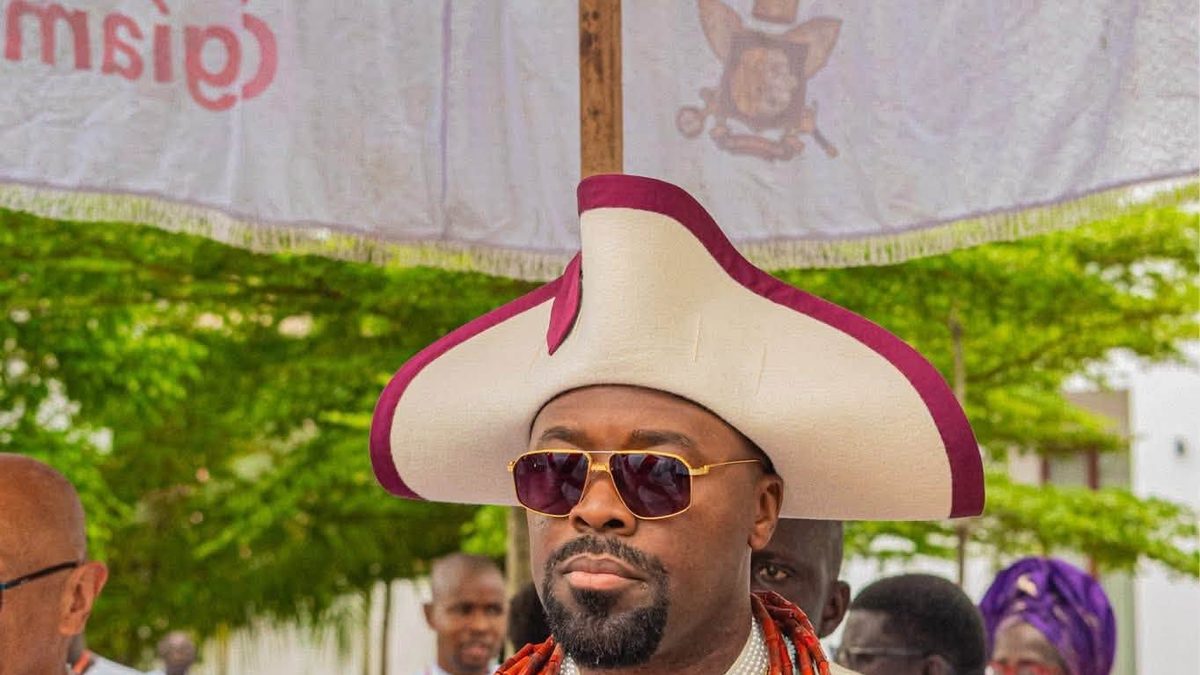
How a 10-day “Global Homecoming” celebration turned the fifth anniversary of the 21st Olu of Warri into a statement about culture, unity, development and the future.
By David Edremoda
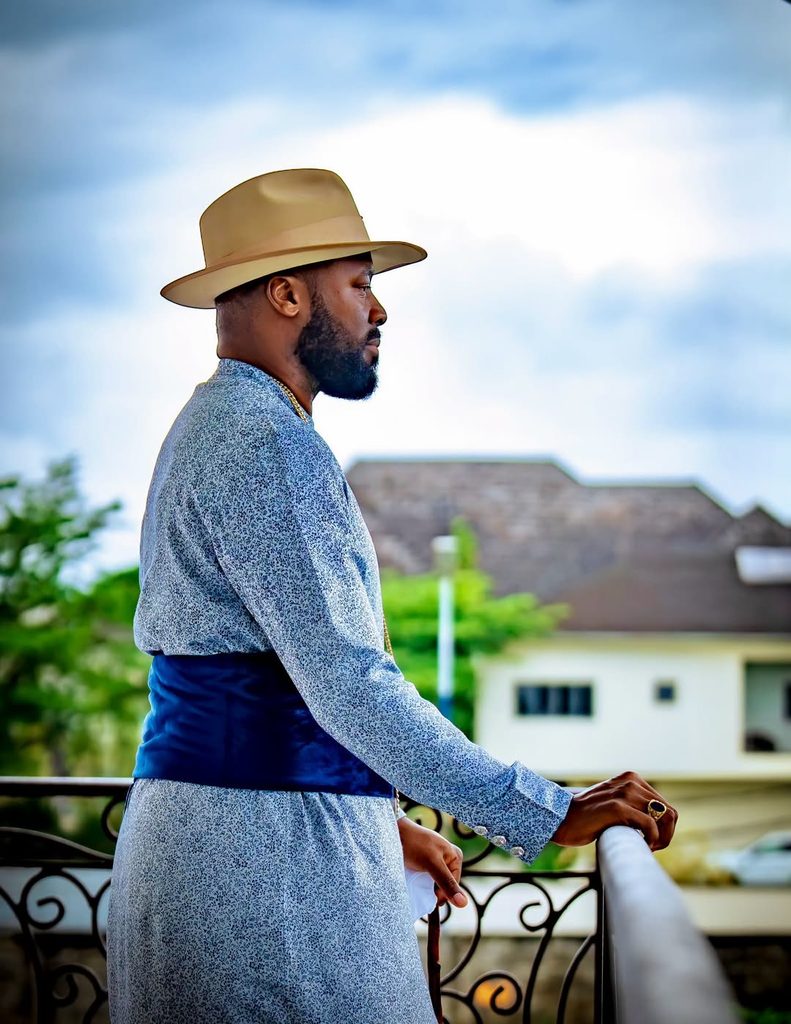
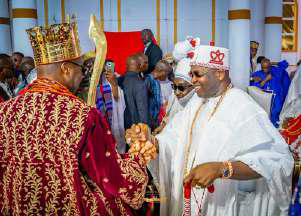
There was something almost poetic about the sight. Five years after he ascended the throne, His Majesty Ogiame Atuwatse III, the Olu of Warri, stood once again at the centre of a gathering that seemed to compress centuries of Warri history into a single moment.
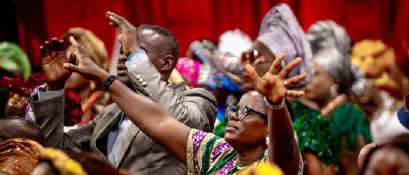
Around him were kings and chiefs, politicians and captains of industry, young people and elders, sons and daughters of the Iwere nation who had travelled from across Nigeria and the diaspora. There were traditional costumes, drums, dancing, boats and sporting activities; there was the pageantry of royalty. But this was not simply another royal celebration.
The fifth anniversary of Ogiame Atuwatse III, the 21st Olu of Warri, became something larger: a ten-day meditation on who the Itsekiri are, where they have come from and, perhaps more significantly, where they intend to go.
From August 14 to 23, 2026, Warri Kingdom opened its doors under the theme, “Global Homecoming: Celebrating Our Cultural Renaissance, Unity and Transformational Progress.” The words were carefully chosen. They captured the three currents running through the celebration: cultural confidence, collective belonging and the conviction that tradition and modern development need not be opposing forces.
For a monarch who ascended the throne on August 21, 2021, the anniversary was also a personal milestone. He had entered history five years earlier as the youngest monarch in the more than 500-year history of the Warri Kingdom. Educated and professionally experienced abroad, he inherited an ancient institution while embodying a generation increasingly at ease in a globalised world.
Five years on, the question is no longer whether the young monarch can wear the crown. It is what he can make the crown mean.

From Coronation to Continuity
The memories of 2021 remain vivid for many Itsekiris. On August 21 that year, the ancient kingdom witnessed the coronation of a new Olu. The young monarch returned to Nigeria to assume an office burdened with generations of history, expectation and responsibility. The coronation was so significant that it became the cover story of alice, the inflight magazine, that month.
The distance travelled since then gives the fifth anniversary its particular significance. Under Ogiame Atuwatse III, the traditional institution has sought a more visible role in conversations around education, youth development, culture, healthcare, peace-building, investment and the future of the Niger Delta.
That evolution was reflected in the anniversary itself. The festivities did not remain confined to the palace. They moved into communities, schools, sporting grounds and waterways. Children spoke Itsekiri; young people competed in football; communities paid homage; boats filled the waterways for a regatta; and thanksgiving brought the celebrations to a close.
The crown, in effect, went out to meet the people.
The ten-day programme was carefully constructed as a journey through the kingdom. It opened on August 14 with Praise Day at Nana College, a fitting beginning for a monarch whose public language repeatedly places gratitude to God at the centre of his understanding of kingship.
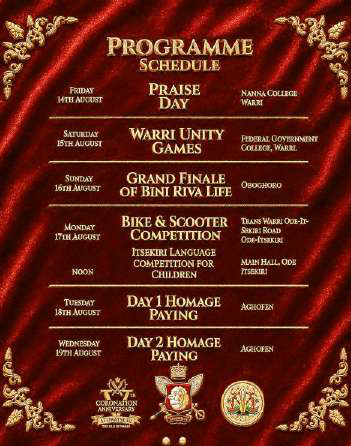


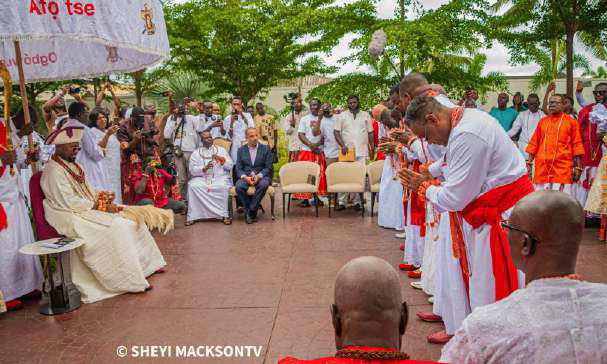
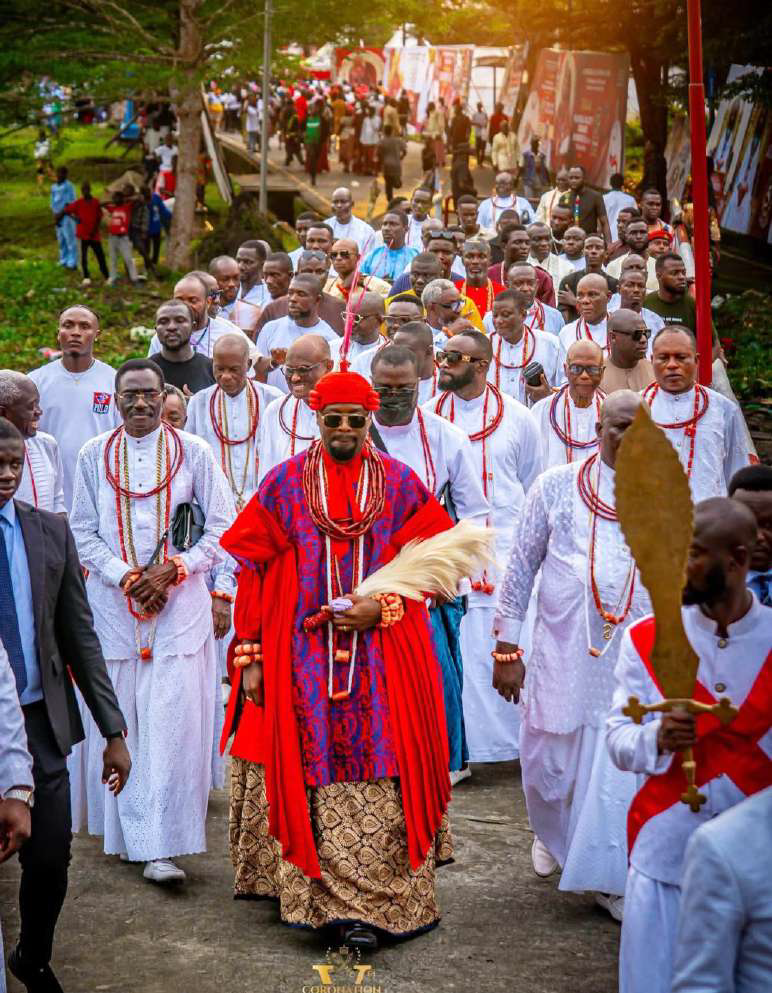


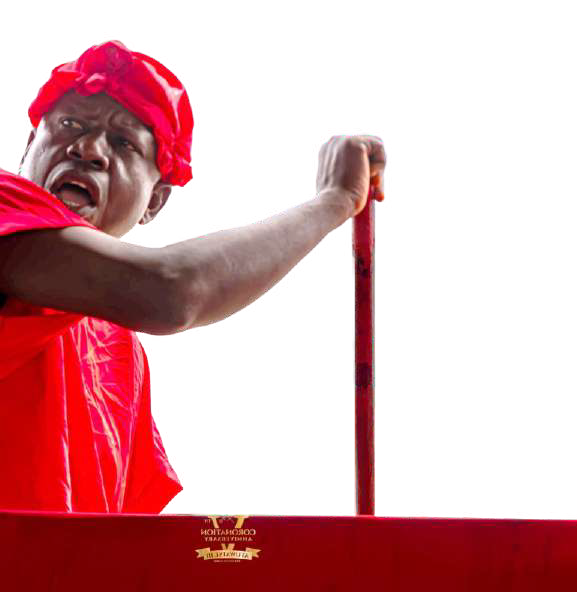
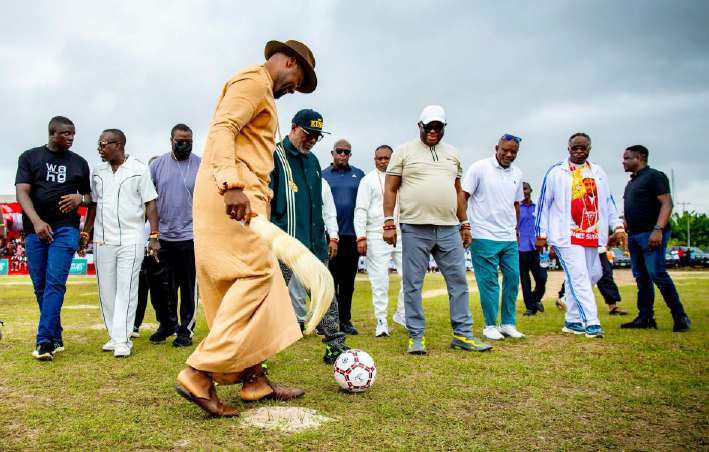
The following day, the Warri Unity Games at Federal Government College brought young people and communities together through sport. Yet the symbolism went beyond competition. During the games, the Olu prohibited his subjects from using the word “slave” in referring to neighbouring communities, arguing that language capable of perpetuating historical grievances had no place in the future he envisaged. It was an important intervention: history must be remembered, but it should not become a permanent prison.
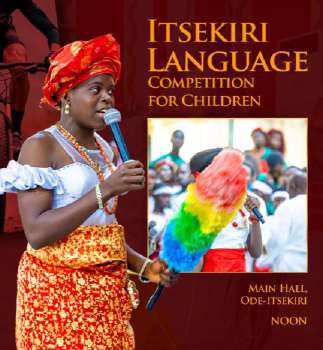
The celebrations subsequently moved through Oboghoro, the Benin River axis and Ode-Itsekiri, the ancestral home of the Itsekiri. A Bike and Scooter Competition sat alongside an Itsekiri Language Competition, an arresting juxtaposition of contemporary recreation and cultural preservation. The message was clear: a people must be willing to modernise without becoming estranged from the language through which their history and worldview are transmitted.
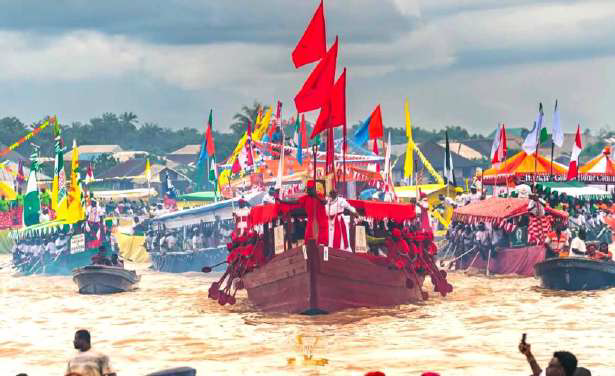
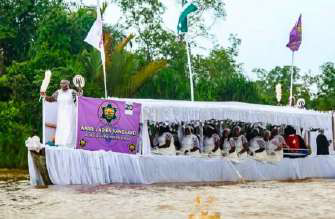
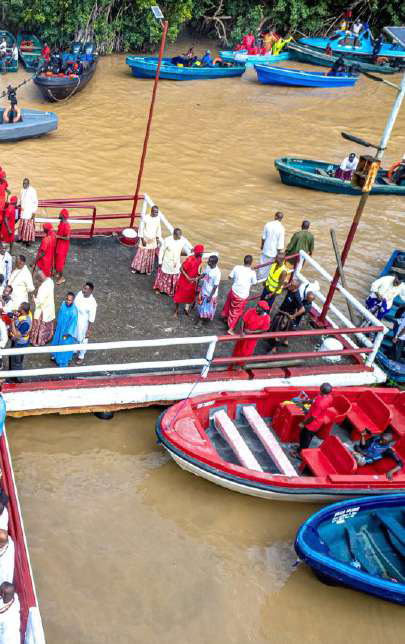
The homage ceremonies that followed transformed the palace into a meeting point for communities and Itsekiris returning from different parts of Nigeria and the diaspora. On August 20, the Royal Boat Regatta at Ode-Itsekiri brought the kingdom’s maritime identity vividly into view. For a people whose history is inseparable from rivers and waterways, the boats were more than spectacle. They were reminders of an economic and cultural inheritance with possibilities for the future.
Then came August 21.






The Crown Speaks
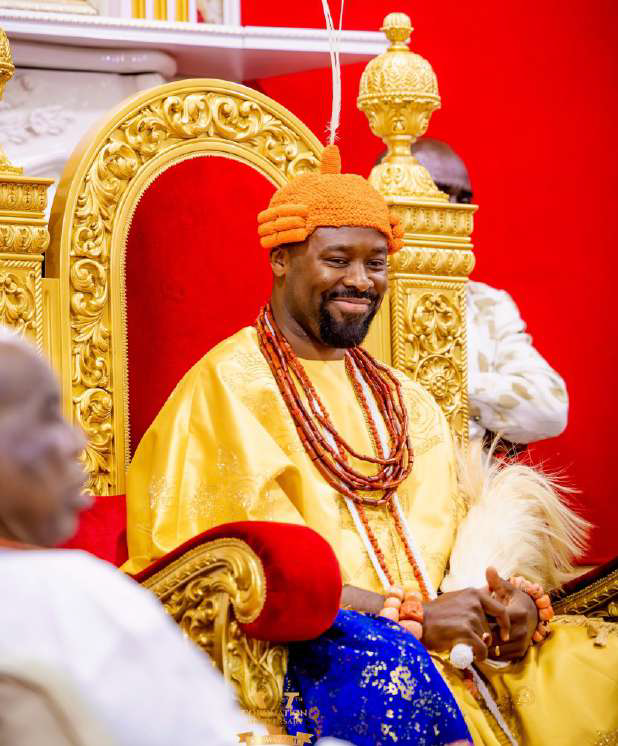
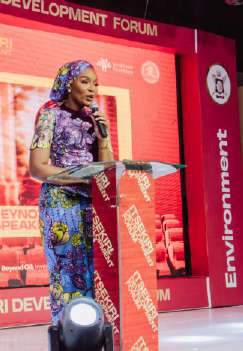
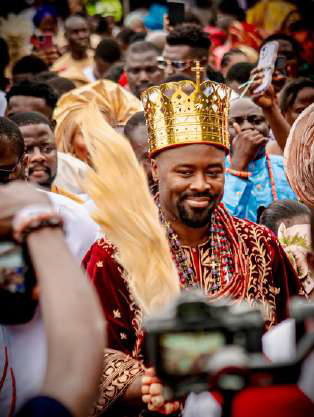
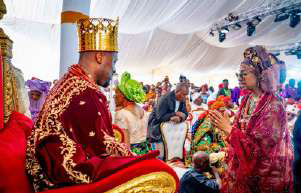
Five years to the day after his accession, the palace at Ajamimogha became the stage for the main anniversary celebration. The breadth of the gathering was itself significant. Governor Sheriff Oborevwori of Delta State and Lagos State Governor Babajide Sanwo-Olu were among the dignitaries present, alongside prominent traditional rulers from across Nigeria, including the Alaafin of Oyo, His Imperial Majesty Oba Akeem Abimbola Owoade I.
Also represented were the Ooni of Ife, Ojaja II; the Elegushi of Ikate-Elegushi, Oba Saheed Ademola Elegushi; the Olowo of Owo, Oba Ogunoye III; the Emir of Zazzau; Amb. Nuhu Bamalli; the Dein of Agbor, Keagborekuzi I; the Ovie of Agbarha-Warri, Igbi II; the Amakosu of Ogbe-Ijoh Warri, Monbene III; the Asagba of Asaba, Epiphany Azinge, SAN; the Obi of Aboh, Oputa III; as well as lawmakers, ministers, business leaders and other prominent Nigerians.
The diversity of the gathering made a point of its own. This was not an Itsekiri celebration in isolation. For ten days, Warri had become a meeting ground for traditional Nigeria.
But the most consequential moment was the Olu’s Speech from the Throne.
Rather than dwell on accomplishments, Ogiame Atuwatse III used the occasion to speak about responsibility and the road ahead. He called for unity, purpose, excellence and collective responsibility, while challenging his people to reconsider inherited practices whenever they obstruct progress.
“We are trying to imbibe a spirit of excellence in this our beautiful regal culture,” he said. “Because I know that when we are excellent in displaying our culture, Nigeria will be the envy of the world.”
For him, the ambition extended beyond the Itsekiri nation. The traditional institution, he argued, could play a significant role in projecting Nigeria’s culture and values to the world.
“It is not just this throne,” he said. “It is the entire traditional institution and it will radiate to the way we do things even in business, the way we do things in educating our children.”
Governor Oborevwori described the Olu as “a cerebral monarch, a peace-builder and an exemplary leader, a man of grace who leads from the front.” He commended the monarch’s contribution to Warri and Delta State and urged the people of Warri, Uvwie and surrounding communities to preserve the peace that has historically enabled different ethnic groups to coexist.

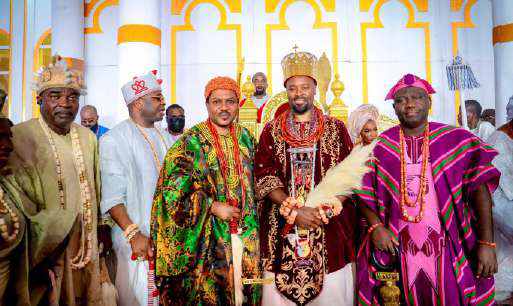

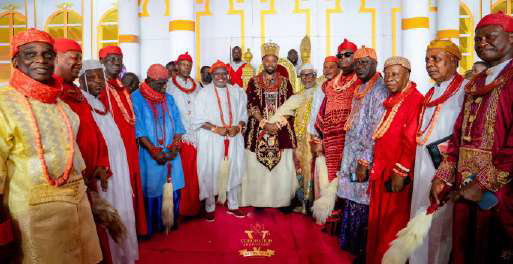
“We have peacefully coexisted for centuries and there is no reason why that cannot continue,” the governor said, urging people to reject inflammatory and divisive tendencies.
Oba Elegushi, another traditional ruler who has followed the Olu’s journey closely, focused on the monarch’s innovation and bridge-building. He described Atuwatse III as a dynamic king who had brought purposeful leadership to Warri while extending friendship to traditional rulers across Nigeria.
The presence of Nigeria’s First Lady, Senator Oluremi Tinubu, also carried particular resonance. In February, the Olu had conferred on her the title Utukpa-Oritse of Warri Kingdom, also known as Ugbone, meaning “Light of God.” She became the first recipient of the title, while her maternal Itsekiri roots made the occasion both a traditional investiture and a homecoming.
Her message then, unity beyond ethnic, religious and political divisions, echoed the anniversary’s central theme. Her Renewed Hope Initiative also donated ₦50 million to support 1,000 women petty traders in the kingdom.
Beyond the Pageantry
A fifth anniversary is inevitably an occasion for assessment. Behind the colour and ceremony, what has the reign produced?
Human-capital development has been one of its clearest priorities. Through the Royal Iwere Foundation, initiatives have focused on education, healthcare, agriculture, enterprise and empowerment. The palace has also supported scholarships, educational interventions, vocational training, healthcare programmes and humanitarian initiatives.
Immediately after the anniversary, the Olu and Olori Atuwatse III commissioned a refurbished six-classroom block at Ologbosere Primary School in Bobi. The project included staff quarters, furniture, solar-powered electricity, potable water and a Love Garden.
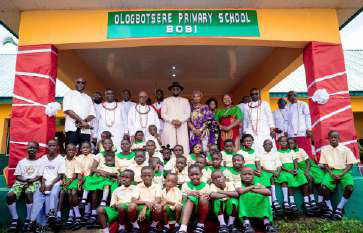
The importance of such an intervention lies not simply in the building but in the principle behind it: children in remote communities should not be disadvantaged by the geography of their birth.
The Olori has been particularly active in this sphere through initiatives such as Wuwu Ore, which focuses on healthcare, education and skills development for underserved communities.
Another significant intervention came during the fourth anniversary in 2025, when the Olu announced the activation of the Iwere Trust Fund with a personal donation of ₦750 million. The fund was conceived as a vehicle for development and welfare across the kingdom, with the monarch calling on sons, daughters and friends of Warri to contribute.
The gesture represented an important shift in emphasis; from royal patronage to collective investment. The underlying proposition was straightforward: if Warri is to change, the people of Warri must invest in Warri.
That philosophy extends to the kingdom’s economic future. Warri has long been identified with oil and gas, but the palace is increasingly speaking the language of technology, entrepreneurship, tourism, maritime enterprise and the blue economy.
The anniversary programme announced the Iwere Innovation Hub, intended to promote digital literacy, software engineering and entrepreneurship among young people. The Federal Government, through the Ministry of Arts, Culture, Tourism and Creative Economy, also entered into a strategic partnership with Warri Kingdom around tourism, investment and youth empowerment.
A king cannot create jobs by proclamation. But a king can help change the conversation about what his kingdom is capable of producing.



That same principle informs the cultural renaissance. The Royal Iwere Society and Royal Order of Iwere have helped position Itsekiri heritage as a living inheritance rather than something confined to museums. The Royal Order, one of the kingdom’s highest honours, recognises individuals whose distinction, integrity and service embody excellence.
The message to younger Itsekiris is subtle but powerful: heritage should not merely tell you where you came from. It should inspire what you become.
Five Years, and the Road Ahead
That is ultimately what made the fifth anniversary different. Its scale was impressive, but its coherence was more important. The Global Homecoming connected cultural preservation with innovation, traditional ceremony with sport, language with education, waterways with economic possibility, and royal diplomacy with national unity.
Most importantly, it treated five years not as a conclusion but as a checkpoint.
The challenges before Warri remain formidable: unemployment, infrastructure deficits, environmental pressures, communal tensions and the difficult transition from an oil-dependent economy. Cultural preservation, too, is increasingly difficult in a rapidly changing world. No monarch can solve all these problems. But a monarch can help determine the spirit in which a people confront them.
The final day, August 23, brought the ten-day celebration to an end with Thanksgiving in Warri. After the speeches, homage, games, boats and ceremonies, the closing note was gratitude: a fitting conclusion for a monarch who repeatedly attributes his journey to God, his ancestors, his people and the grace he believes has accompanied the throne.
Five years earlier, the people had gathered to crown a king. Five years later, they gathered to take stock. The distinction matters. A coronation asks a people to welcome a monarch; an anniversary invites them to consider what has happened since. The answer offered by the ten-day celebration was not perfection. It was movement.
A kingdom reconnecting with its history. A people being encouraged to preserve their language. Young people being equipped for a changing economy. Communities being urged to choose peace over grievance. A traditional institution seeking relevance in a modern Nigeria. At five, Ogiame Atuwatse III appears to be making a larger argument about the meaning of a crown: that its worth lies not in the splendour it commands, but in the future it helps its people imagine and, ultimately, build.