
The Final Curtain Falls on a Yoruba Cinema Giant, Taiwo Hassan
By David Edremoda

Some actors appear in films; others become part of the language through which a culture remembers itself. Taiwo Hassan, popularly known as Ogogo, belonged to the latter class. For more than four decades, his voice, bearing, gestures and commanding Yoruba delivery gave life to kings and chiefs, fathers and warriors, policemen and drivers, villains and men of consequence. He possessed the rare ability to enter a scene and alter its atmosphere before uttering a word.
Then, on Sunday, August 23, 2026, the voice fell silent.
Hassan died at 66 after a battle with stage-four cancer, bringing to a close a remarkable career that began in theatre in the early 1980s and traversed the cassette and VCD eras, the rise of Nollywood, the expansion of Nigerian cinema and, finally, the age of global streaming. His death was confirmed by his daughter, Kira Hassan, and by veteran actor Jide Kosoko.
For Nigerians who grew up with Yoruba films on television, videocassettes and VCDs, Ogogo was more than an actor. He was part of the furniture of memory: a familiar face from childhood, a voice from another room, a presence whose arrival could instantly change the temperature of a film.
His passing therefore feels larger than the death of an individual performer. It marks the departure of one of the principal figures of a generation that helped construct Yoruba cinema almost from the ground up.
The last battle
The circumstances of Ogogo’s final weeks made his death particularly poignant. In August, his daughters, Kira and Haleemah, publicly appealed for medical assistance after revealing that their father had been diagnosed with advanced cancer. According to the family, the illness had been discovered only weeks earlier and had affected his abdomen. They said earlier symptoms had initially been treated as an ulcer before subsequent examinations revealed the seriousness of his condition.
The family sought specialists and explored possibilities for further treatment. At one point, the daughters appealed to hospitals and medical experts after being told that conventional chemotherapy was no longer feasible. They also considered treatment abroad, but his deteriorating condition reportedly left him medically unfit to fly.
For a few days, Nigerians watched anxiously as colleagues, friends and admirers rallied around the family. Then came an earlier false report of his death, which the family dismissed. Days later, the dreadful rumour became reality.
Kira’s announcement on Instagram Live was almost unbearably simple: “My daddy is dead. I can’t believe it.”
There are moments when the machinery of celebrity disappears and only the human being remains. That was one of them. The country was not merely mourning Ogogo the actor; his daughters were mourning their father.
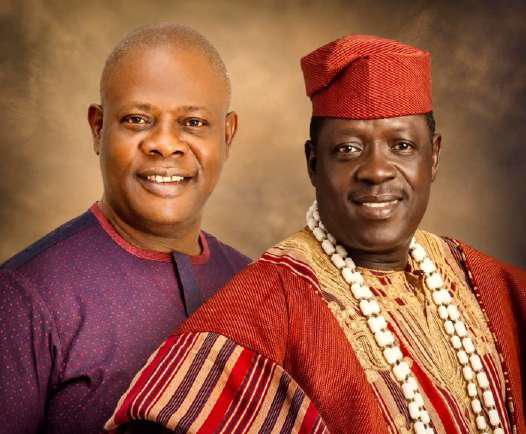
He was buried the following day, August 24, in his hometown of Ilaro, Ogun State, according to Islamic rites. Family members, community leaders, friends and some of the most recognisable names in Yoruba cinema gathered for the final farewell.
Among the mourners was Yinka Quadri, Ogogo’s friend and colleague of more than four decades. Quadri’s recollection of his final visit to the hospital offered perhaps the most intimate portrait of the actor’s last days. Seeing his friend on the sickbed, Quadri broke down in tears. Ogogo, still trying to reassure him, reportedly said, “Yinka, don’t cry. Nothing bad will happen to me.”
The poignancy of those words lies in what neither man could know: within days, Ogogo would be gone.

From mechanic to cinema institution
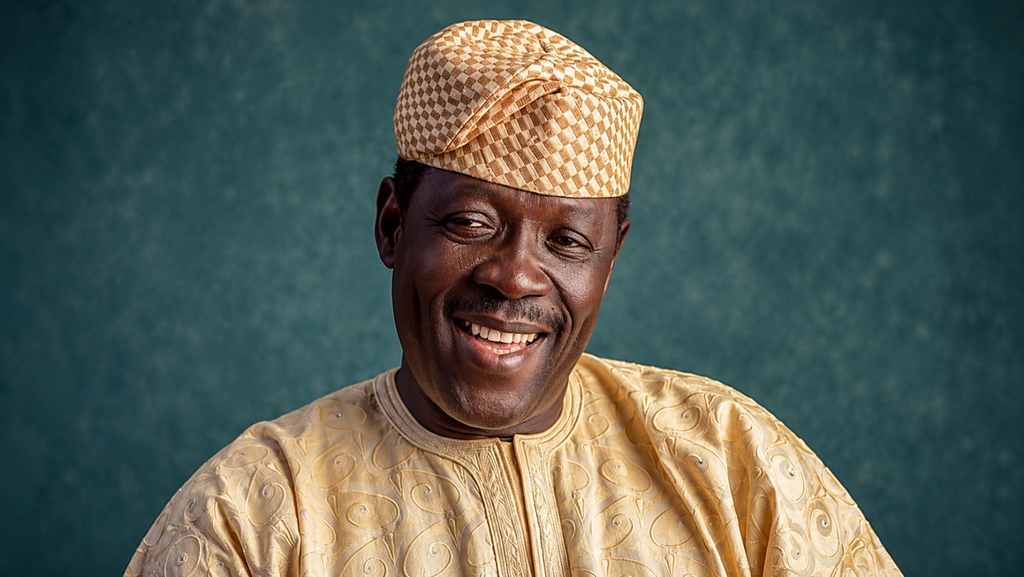
Taiwo Hassan’s journey to stardom was anything but conventional. Born in Ilaro on October 31, 1959, he trained as an automobile mechanic and spent about 13 years working with the water corporation while pursuing acting. He began acting in 1981, balancing employment with the vocation that increasingly demanded his attention. In 1994, he finally left his government job to become a full-time actor.
That decision changed the course of his life; and, in a modest but important way, the history of Yoruba cinema.
Ogogo emerged from the practical theatre culture that nurtured many of the industry’s most durable performers. He was part of a generation for whom acting was not initially a glamorous profession but a craft learned through rehearsal, performance, travel, discipline and apprenticeship. His career therefore carried something of the old Yoruba travelling-theatre tradition into the modern film industry.
His breakthrough came with Tade Ogidan’s Owo Blow, in which he played Wole Owolabi. The role transformed his public profile and earned him the Best Actor award at the 1997 THEMA Awards.
After Owo Blow, Ogogo became increasingly difficult to overlook. He appeared in productions including Elewon, Danfo Driver, Agbelebu, Agbo-Odaju, Omo Ghetto, Amerah, Bank Alert and IGE, among many others. His filmography crossed genres and generations, but his essential qualities remained constant: authority, physicality, vocal command and a deeply instinctive understanding of character.
He could play a king without theatrical excess, a father without sentimentality, a villain without caricature and a man of the street without diminishing his dignity. He understood that screen authority does not always require shouting. Sometimes it resides in silence, a pause, a glance or the measured delivery of a single line.
His Yoruba was another instrument. Rich in rhythm, idiom and cultural resonance, it gave his performances a particular gravity. He did not merely speak the language; he inhabited it. In his hands, dialogue could carry the texture of generations.This was why Ogogo became more than a successful actor. He became an archetype.
From Nollywood’s old world to the streaming age
Perhaps the most revealing measure of Ogogo’s importance was his ability to remain relevant while the industry around him changed almost beyond recognition.
He belonged to the era of analogue cameras and videocassettes. He survived the transition to VCDs, television syndication and cinema. Then, remarkably, he found himself in the streaming age, appearing before audiences far beyond the traditional boundaries of Yoruba-language cinema.
Kunle Afolayan’s Aníkúlápó provided one of the clearest demonstrations of this late-career reach. Ogogo played the Alaafin of Oyo in the 2022 film, bringing to the role the same authority that had distinguished his earlier work. The performance earned him a nomination for Best Supporting Actor at the 2023 Africa Magic Viewers’ Choice Awards.
He later reprised the character in Aníkúlápó: Rise of the Spectre, the Netflix series released in 2024.
There was something symbolically satisfying about this. An actor formed in the old theatre tradition had crossed into a digital world capable of carrying Yoruba storytelling to viewers across continents.
Ogogo was not imprisoned by nostalgia. He belonged to the past, certainly, but he remained capable of speaking to the present.
That continuity matters because Yoruba cinema is not simply an entertainment industry. It is also a repository of language, costume, history, mythology, social values and collective memory. For generations of viewers, actors such as Ogogo provided a living bridge between inherited culture and contemporary popular entertainment. His death therefore represents not merely the loss of a star but the thinning of a particular cultural generation.
The tributes that followed revealed the breadth of that loss. Colleagues described him as a pillar, a father, a mentor, a legend and a custodian of culture. Ogun State called him a shining light whose work helped project Yoruba heritage beyond Nigeria, while Lagos State described him as a gifted storyteller and cultural ambassador.
President Bola Tinubu similarly praised Hassan’s contribution to Nigerian storytelling and cultural preservation, describing his body of work as part of the country’s cultural history.
Yet perhaps the most moving tributes came not from official statements but from the people who knew him intimately.
Quadri’s grief at the funeral in Ilaro was particularly difficult to witness. For decades, audiences had watched the two men as actors, sometimes as adversaries, sometimes as allies, always as commanding presences. At the funeral, there was no script, no director and no second take. There was simply one old friend saying goodbye to another.
That image captures something essential about Ogogo’s legacy. His importance cannot be measured by awards or film credits alone. He was important because he belonged to people.
He belonged to the audiences who grew up watching him. He belonged to colleagues who shared locations, rehearsals, journeys and arguments with him. He belonged to the theatre tradition that shaped him. And, most intimately, he belonged to his family, who knew him not as Ogogo the celebrity but as Daddy.
That is perhaps the deepest sorrow in his final chapter. Nigerians wanted more films. Colleagues wanted more years. His daughters wanted more time with their father. But mortality does not negotiate, and even the most accomplished actors eventually leave the stage. On August 23, the curtain came down on Taiwo Hassan. But the character called Ogogo remains.
He remains in the old films still watched in Nigerian homes; in the cadence of Yoruba dialogue; in the performances of actors he influenced; in the memories of audiences who encountered him decades ago; and in the continuing evolution of a film culture to which he gave so much of his life. He remains in Ilaro, where he began and where he was finally laid to rest.
And he remains in the larger story of Nigerian cinema: the story of a mechanic who answered the call of theatre, a performer who became a star, and a star who, over four extraordinary decades, became an institution. The final curtain has fallen. But the performance endures.