

On a quiet Los Angeles night, history bent gently toward justice as the world finally inscribed Fela Anikulapo-Kuti: musician, rebel, and moral provocateur, into the canon of global sound, affirming that art born of defiance can outlive repression, borders, and time itself.
By David Edremoda
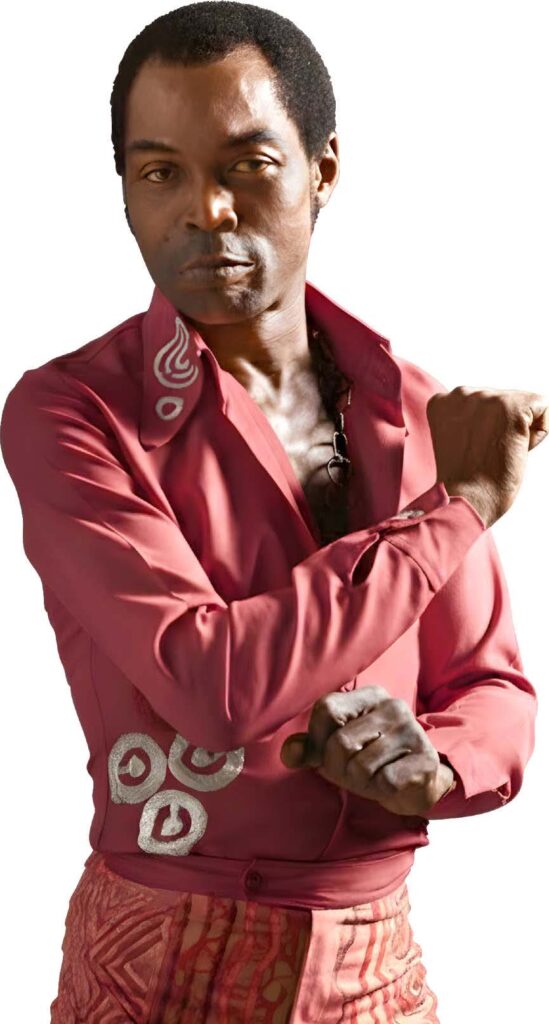
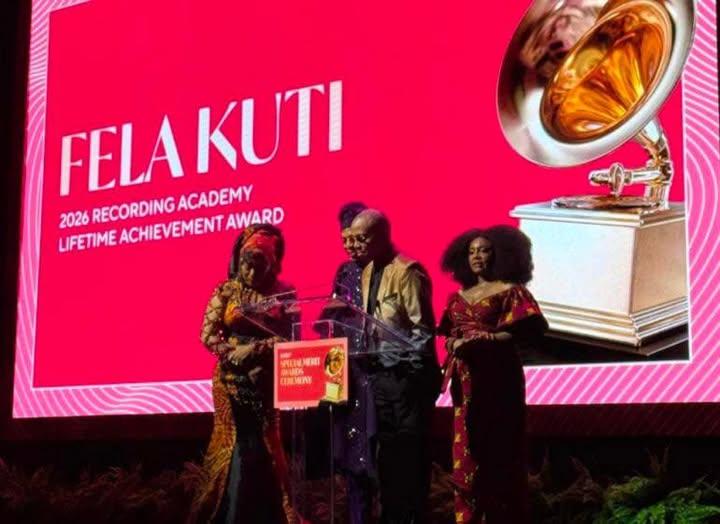
On the evening of January 31, 2026, a quiet gravity settled over the Wilshire Ebell Theatre in Los Angeles. The historic venue, an intimate jewel of old Hollywood, known since 1927 for hosting statesmen, thinkers, and musical luminaries, was neither roaring nor resplendent with spectacle. Instead, it hummed softly with anticipation, as though history itself had leaned in to listen. On that night, the Recording Academy acknowledged a truth long evident to millions across continents: that the music of Fela Anikulapo-Kuti had permanently altered the grammar of global sound.
At the Special Merit Awards ceremony, held on the eve of the 68th Annual Grammy Awards, the late Afrobeat pioneer was posthumously conferred with the Grammy Lifetime Achievement Award. It was a moment that felt less like celebration than consecration. No thunderous applause, no televised excess: just red velvet seats, warm lights, and the collective recognition of peers bearing witness to an overdue canonization.
For an artist who spent his life in open confrontation with authority; political, cultural, and institutional, the modesty of the setting felt profoundly appropriate. This was not about amplifying celebrity. It was about inscribing history. A room filled with musicians, archivists, and inheritors gathered to affirm that Fela’s work did more than entertain; it reshaped how music could speak truth, mobilize bodies, and challenge power.

A Theatre of Memory
The Wilshire Ebell’s auditorium is human in scale, almost devotional. A shallow balcony curves above the orchestra seats; the plasterwork softens the proscenium; the space recalls an era when performance demanded presence rather than distraction. The ceremony’s staging honored that intimacy. At center stage stood a single podium, unadorned, its microphone positioned for personal address. Behind it, a screen cycled through images from Fela’s life; grainy, defiant, alive.
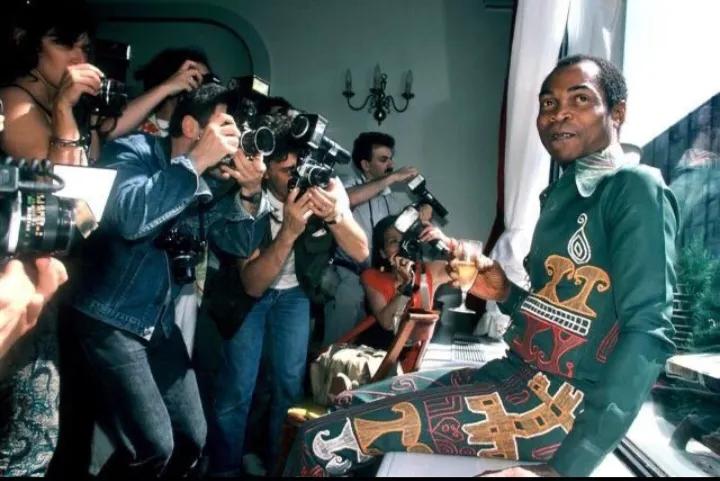
There was Fela as a young student in London, trumpet in hand, eyes alert with possibility. Fela mid-performance in Lagos, fist raised above a sea of bodies. Fela frozen in sweat and brass in the 1970s, the music almost visible in the tension of his stance. These were not polished promotional images but documentary fragments; rehearsal shots, torn-edged photographs, iconic album covers designed by Lemi Ghariokwu. They carried the dust, urgency, and danger of their time.
Presenters approached the podium not as entertainers but as custodians of memory. Their remarks felt closer to eulogies than introductions; measured, affectionate, occasionally fierce. When members of the Kuti family stepped forward to accept the honor, the theatre seemed to exhale. The moment carried the weight of decades: of raids and resistance, of exile and return, of a man long dismissed as a troublemaker now recognized as a foundational figure in modern music.

The Family and the Moment
The Recording Academy had announced the 2026 Special Merit honorees in December 2025. The list read like a pantheon: Paul Simon, Carlos Santana, Chaka Khan, Whitney Houston and Fela. The Academy framed the award as recognition of “outstanding artistic significance” across a lifetime. Few lives embodied that phrase more fully.
On stage, Fela’s children accepted the award on his behalf. Femi Kuti, torchbearer of the Afrobeat lineage, spoke for the family. Yeni Kuti stood beside him, alongside other relatives. Their presence alone told a story of continuity; of inheritance shaped by both music and struggle. Femi wore a regal purple agbada with a matching cap; Yeni, a flowing gown of red, purple, and brown. The effect was ceremonial yet grounded, dignified without distance.
“Thank you for bringing our father here,” Femi said simply. “It’s so important for us. It’s so important for Africa. It’s so important for world peace and the struggle.”
In that sentence, the award expanded beyond individual recognition. It became continental, historical, political. Fela, who died in 1997, thus became the first African to receive the Grammy Lifetime Achievement Award; more than three decades after his death. Other icons shared the honour, but the symbolic weight of this first was unmistakable.
Yeni Kuti later described the recognition as “better late than never,” noting that her father had never been nominated for a Grammy in his lifetime. “We still have a way to go,” she said, speaking to the broader underrepresentation of African musicians within global institutions. Reflecting on Fela himself, she added that he likely would not have cared much for the award. “He played music because he loved music,” she said. “What mattered to him was being acknowledged by people; by fellow human beings.”
Yemisi Ransome-Kuti, Fela’s cousin and head of the Kuti family, echoed that sentiment. Fela, she said, was never driven by popular approval. He was focused on impact, on how his work could confront injustice and awaken consciousness.
Lemi Ghariokwu, the visual artist behind 26 of Fela’s album covers, captured the irony of the moment with gentle humour. “Fela was totally anti-establishment,” he observed. “And now, the establishment is recognizing him.” He imagined Fela raising his fist and laughing: You see? I got their attention.
The tribute performances that evening reflected Fela’s complexity. Rather than attempt an impossible recreation of Afrobeat’s full-scale orchestration, the ceremony adopted a restrained, interpretive approach. Small ensembles teased out fragments of his compositions; tribute clips flooded the room with polyrhythms and chants. Elsewhere, DJs and musicians carried the celebration into the night, playing extended sets that honored Afrobeat’s communal, ecstatic roots.
One performer, known for embodying Fela in theatrical productions, reportedly led a tightly arranged tribute that translated Afrobeat’s sprawling architecture into an intimate register. It was less reenactment than invocation; a reminder that Fela’s music resists containment, that it lives most fully in movement and memory.
The resonance of Fela’s recognition was amplified by the company he kept. The Lifetime Achievement Award is reserved for artists who have altered the musical map. In 2026, it gathered figures whose work spanned decades and continents. The juxtaposition mattered. It placed Afrobeat not at the margins of global music history, but firmly within its core.
That context extended into Grammy Sunday itself. Bad Bunny made history with the first all-Spanish-language Album of the Year. Tyla won Best African Music Performance. Together, these moments traced a line from Fela’s insurgent experimentation to today’s global soundscape; one in which African and diasporic rhythms are no longer peripheral but central.
From Abeokuta to Kalakuta
To grasp why this moment resonates so deeply is to revisit the life that produced it. Born Olufela Olusegun Oludotun Ransome-Kuti in 1938 in Abeokuta, Fela emerged from a family steeped in activism. His mother, Funmilayo Ransome-Kuti, was a towering figure in Nigerian feminism and nationalism. Politics, protest, and public engagement were woven into his inheritance.
Fela’s decision to study music at Trinity College of Music in London marked a decisive turn. There, he absorbed jazz discipline and formed Koola Lobitos. Later, in the United States, he encountered the Black Power movement. A relationship with activist Sandra Izsadore proved transformative, introducing him to the writings of Malcolm X, Angela Davis, and Huey Newton. Fela later said his “head was turned.” He had found a vocabulary for his anger and a theory for his instincts.
Returning to Nigeria, he fused funk, jazz, Yoruba rhythms, and political critique into Afrobeat; a form that was as architectural as it was insurgent. His songs were long, repetitive, incantatory. They demanded attention. They taught through dance.
Fela’s music named names. “Zombie” mocked the Nigerian military’s blind obedience and provoked one of the most violent reprisals in the country’s cultural history. In 1977, soldiers raided Kalakuta Republic, Fela’s self-declared commune, beating residents, burning instruments, and throwing his mother from a window. She later died from her injuries.
Other songs deployed irony, sorrow, and grotesque humour. “Sorrow, Tears and Blood.” “Gentleman.” “Expensive Shit.” Each transformed music into civic space. Through repetition and call-and-response, Fela gathered bodies into political awareness. His music was sermon and carnival, protest and pleasure.
When Fela died on August 2, 1997, Lagos mourned in procession. Hundreds of thousands turned his funeral into a civic ritual. Since then, his afterlife has only expanded, through Broadway productions, academic studies, museum exhibitions, and the annual Felabration festival. His music continues to be sampled, debated, and danced to by generations who never saw him perform live.
The Grammy Lifetime Achievement Award is the latest chapter in that afterlife. It is not closure, but recognition, an inscription into the official ledger of global music history.
To call the award a mere trophy is to miss its significance. It represents an institutional acknowledgment of a man who rejected institutions, a reconciliation between canon and critique. For African musicians, it is both validation and challenge: proof that global recognition is possible, and a reminder that it often arrives late.
If there is one enduring image from that night, it is not gold or velvet but continuity—the Kuti family on stage, the grooves still circulating, the message undiluted. Fela taught the world how to make the political danceable and the dance political.
On that January night in Los Angeles, the world finally said what his audiences had always known. Fela lives.