
Deep in Ekiti’s rolling hills and forested landscapes, history stirs anew as Nollywood reimagines the thunderous Kiriji War, blending cinema, cultural memory, and heritage preservation into an ambitious epic of identity, power, and resistance
By David Edremoda

Deep in the undulating hills and forested valleys of Ekiti State, a thunder long consigned to history has begun to roll again. This time, however, it is not the reverberation of Dane guns splitting the air, but the controlled chaos of cameras, actors, and crews reanimating one of Yorubaland’s most consequential conflicts: the Ekiti–Parapo War, more commonly known as the Kiriji War.
Nollywood’s finest are presently on location in Ekiti, shooting a war epic that seeks not merely to dramatise a nineteenth-century conflict, but to reclaim historical memory with cinematic authority. The name “Kiriji” itself is onomatopoeic, drawn from the thunderous sound produced by the heavy-muzzled firearms that defined the war’s later years. Intriguingly, Yoruba history preserves a parallel linguistic phenomenon: during the mid-nineteenth-century clash between the Oba of Lagos and British forces over the abolition of the slave trade, the booming cannons gave rise to the word Agidimgbi. Sound, it seems, has always been one of history’s most enduring witnesses.
The physical world being assembled for the film is arresting in its fidelity to the pre-colonial imagination. This was the era after the collapse of the Old Oyo Empire, when power fractured and the Ibadan city-state rose as a formidable military force. At the entrance to the recreated city stands a dark, imposing gate crowned by an arch. Bas-relief images; crowns, yams, symbols of sustenance and authority, announce the civilisation within. Above, a narrow battlement holds the akoda, the traditional sentinel watching for enemies on the horizon.
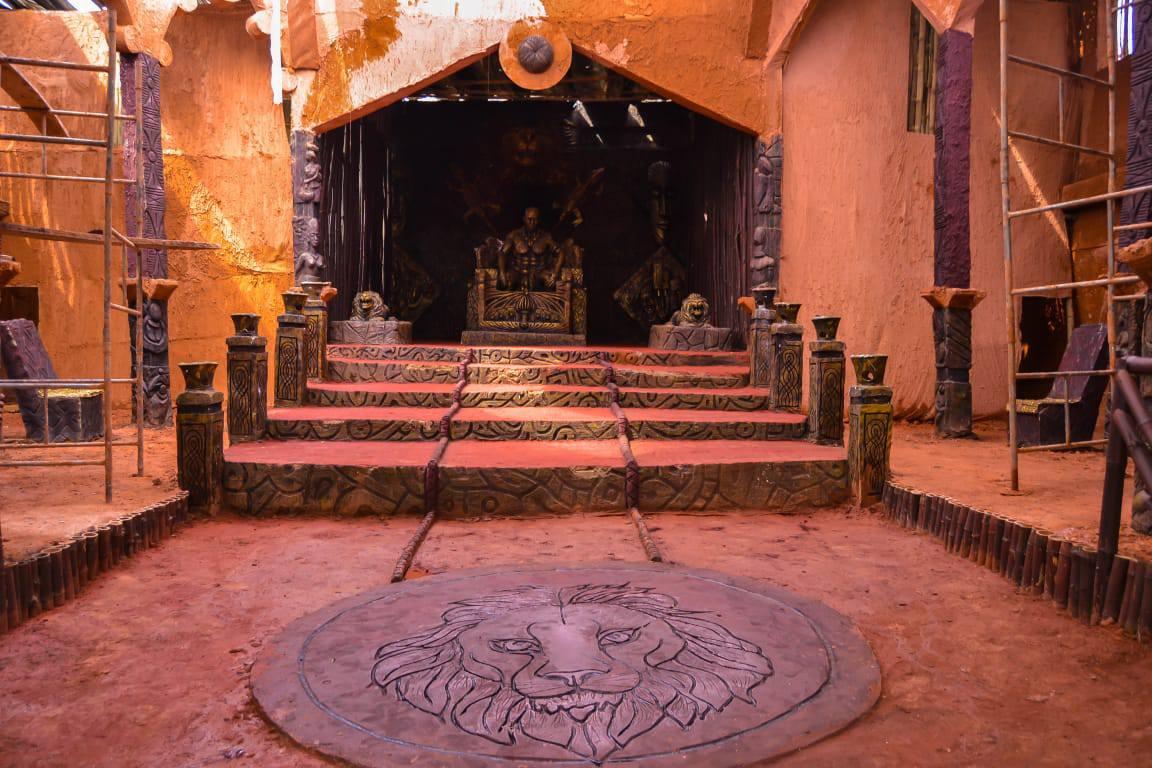
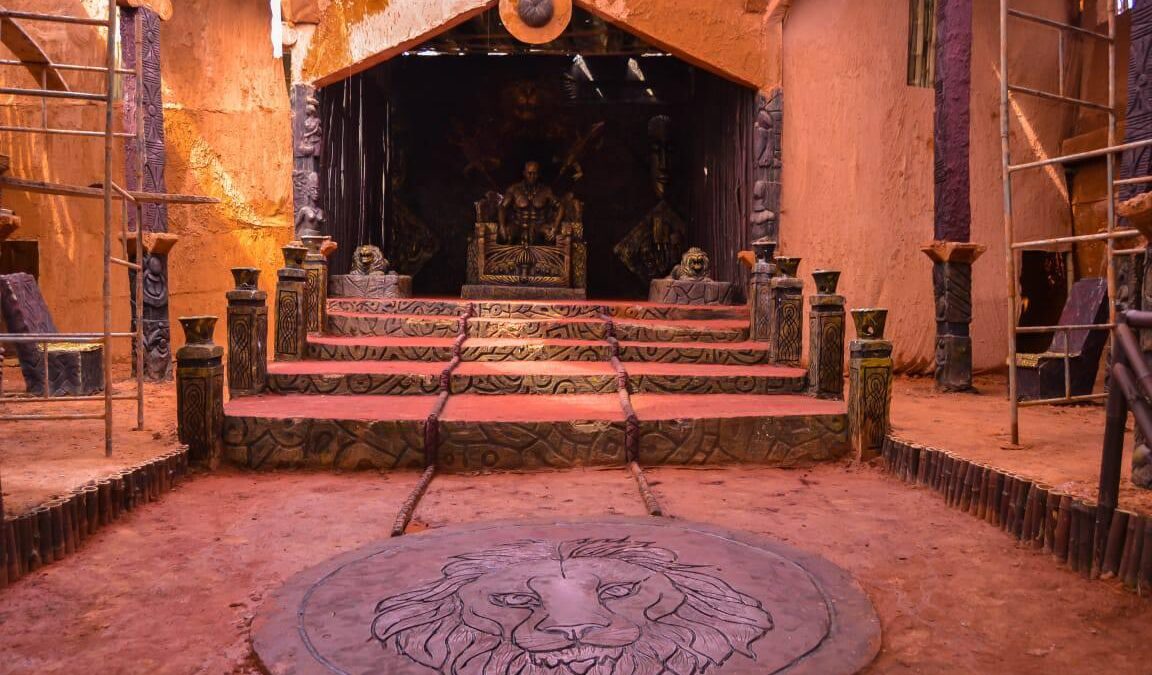
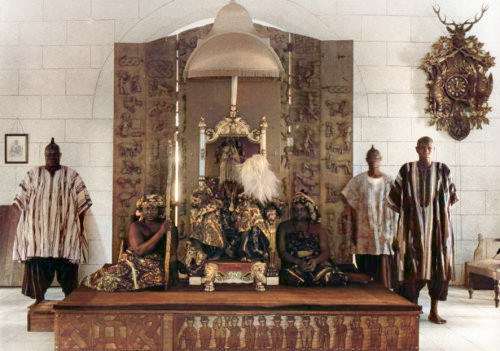
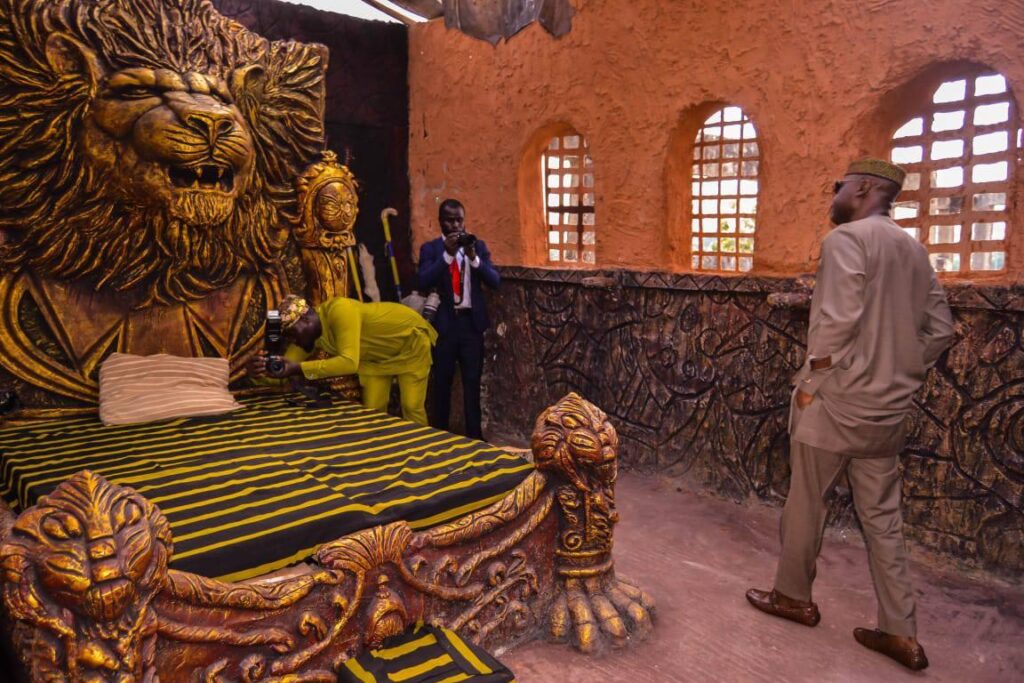
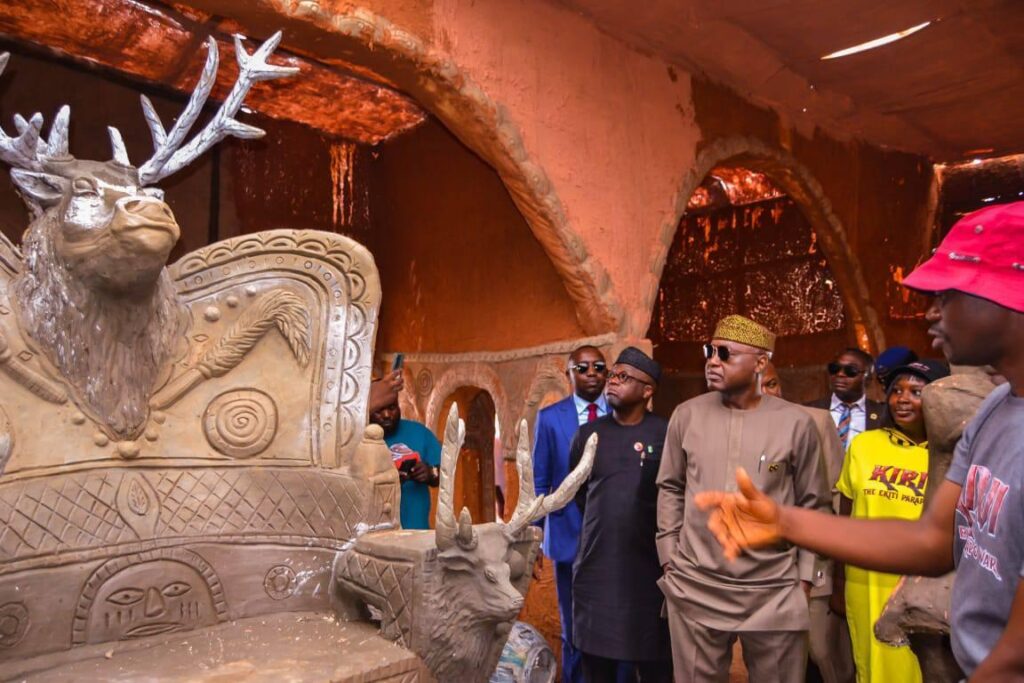
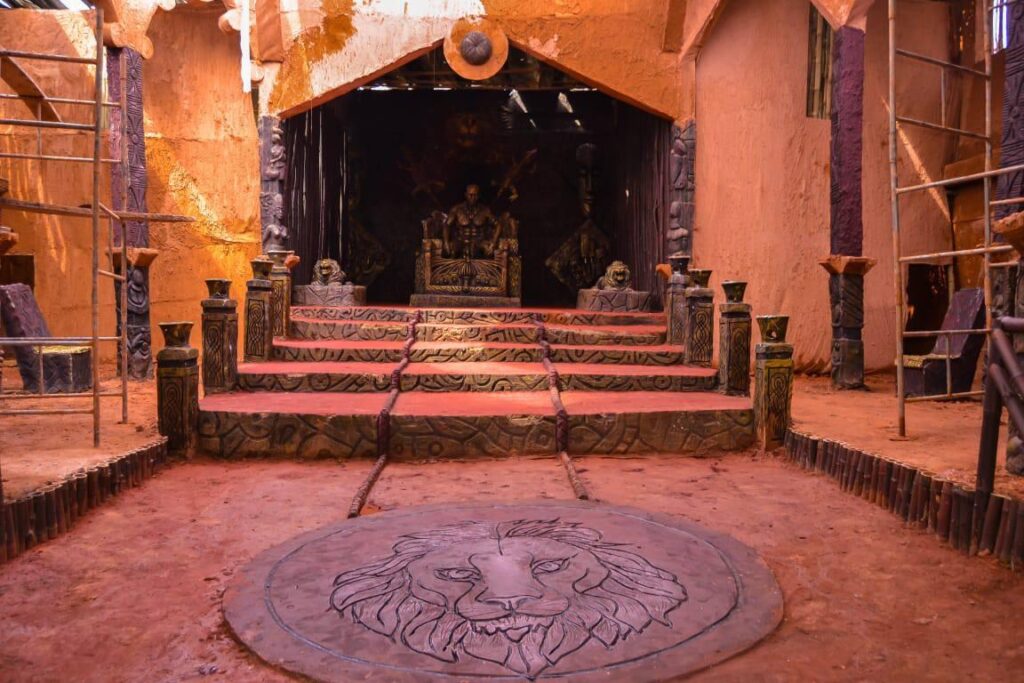
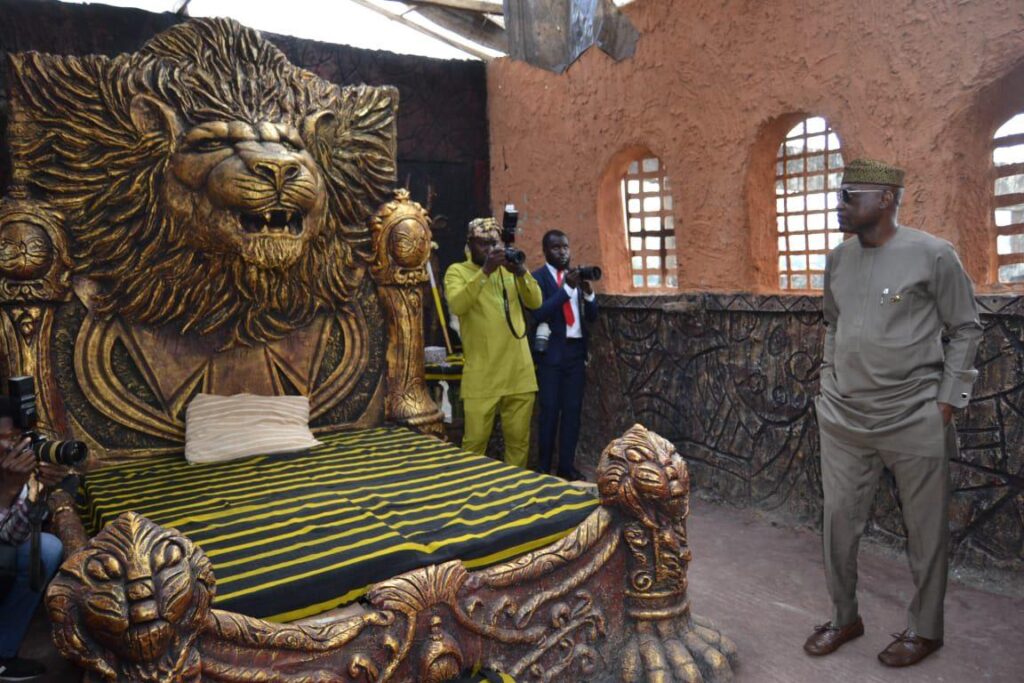
Within the royal quarters, power is rendered in wood and symbolism. An ornate bed carved with a lion’s head anchors the king’s private space. A ceremonial seat bearing the antlered head of the agbanrere (reindeer) speaks to dominion and prestige. The royal court itself unfolds in stately browns and beiges, defined by five steps, four imposing pillars, and a central throne flanked by sculpted lions. The visual resonance recalls imperial palaces far beyond Yorubaland; one is reminded, unavoidably, of the throne room of Emperor Haile Selassie of Ethiopia.


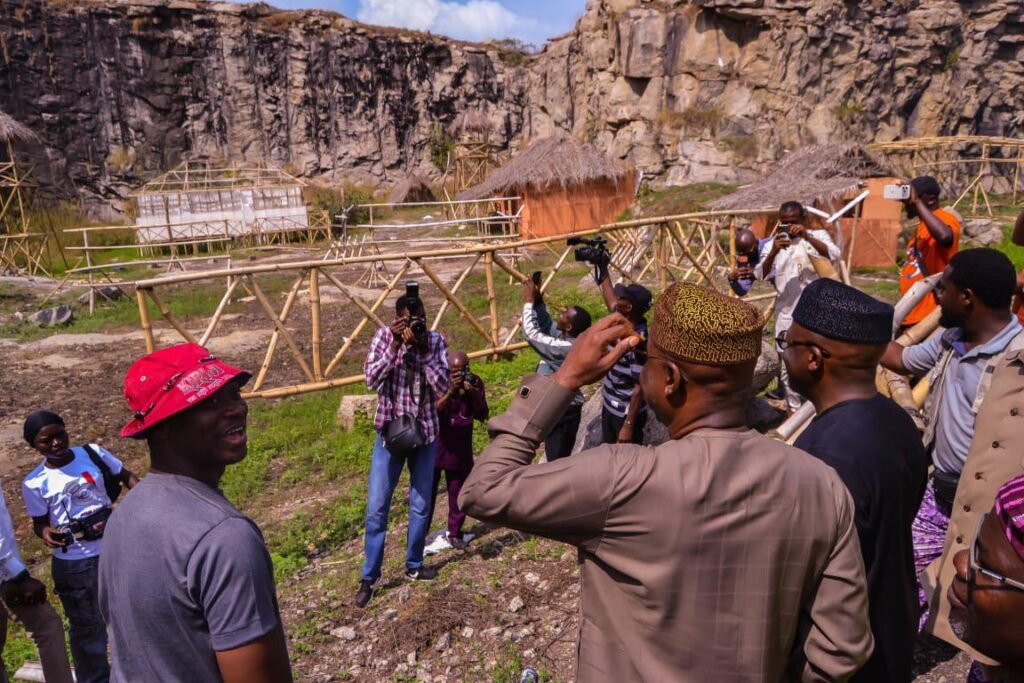


Elsewhere, the terrain opens into a vast hollow, cavernous and circular, evoking a Roman amphitheatre. It is here, amid carefully choreographed disorder, that history meets performance. Costumes, props, and geography cohere into a convincing pre-colonial world. And already, Nollywood’s leading lights have stepped into it, embodying warriors, rulers, emissaries, and rebels whose choices once shaped the destiny of a people.
The origins of the project are themselves rooted in deliberate cultural intention. In January 2025, celebrated Nollywood couple Lateef Adedimeji and Adebimpe “Bimpe” Adedimeji paid a courtesy visit to the Governor of Ekiti State, Biodun Oyebanji, in Ado-Ekiti. That meeting set in motion a collaboration between the Ekiti State Ministry of Arts, Culture and Creative Economy and AL Notions Film Company, owned by the couple.
The Governor approved the partnership with a clear vision: to tell the story of the Kiriji War in rich detail and to a standard capable of standing confidently on the global stage. While the project is fully funded by private capital, it is being driven by AL Notions Film Company, producers of the acclaimed epic Lisabi, working in close partnership with a technical and historical team from the Ekiti State Ministry of Arts, Culture and Creative Economy. The ministry is led by Professor Rasaki Ojo Bakare, one of Africa’s most accomplished artistic directors, whose career bridges scholarship and stagecraft.
For Adebimpe Adedimeji, an indigene of Ijero-Ekiti, the project carries personal as well as professional significance. She and her husband have expressed deep excitement at leading the production and have pledged uncompromising commitment to historical accuracy, artistic excellence, and narrative integrity. With towns and villages across Ekiti State serving as principal locations, the film promises not only authenticity, but wide local participation, including artistes of Ekiti origin.
By early 2026, production was fully underway. Governor Oyebanji recently toured several filming locations in Ado-Ekiti, with major scenes shot at expansive sites in Odo-Uro, Iyin-Ekiti. He described the project as a significant catalyst for tourism development, arguing that the film transcends historical documentation to become a strategic instrument for cultural projection.
Ekiti’s rolling hills, dense forests, rocky outcrops, and serene rural settlements provide natural cinematic grandeur. In the Governor’s assessment, these landscapes are not merely backdrops but assets capable of attracting global attention, tourism, and creative investment.
Following the tour, the Governor; accompanied by senior officials across culture, tourism, information, and administration, reaffirmed his administration’s commitment to preserving Ekiti history as a tool for identity formation, education, and economic development. While clarifying that the state government is not a direct financier of the film, he disclosed that he mobilised support from friends and associates committed to promoting Ekiti’s heritage.
“A people without history are a lost people,” he observed. “What is being filmed here is part of our collective memory, now being preserved for generations yet unborn. When this work is released, Ekiti people will see themselves reflected with pride, because we are telling our own story and showcasing our land to the world.”



The War Behind the Spectacle
The Kiriji War itself remains one of the longest and most complex civil wars in Yorubaland, lasting sixteen years from 1877 to 1893. Like many epochal conflicts, its origins combine power, pride, and deeply personal grievance. There is a striking parallel here with Mel Gibson’s Braveheart, where the abuse of women symbolised domination and ethnic humiliation. Even older mythologies, from Helen of Troy onward, echo the same grim pattern.
In Yorubaland, the immediate spark was the oppressive Ajele system imposed by Ibadan over conquered territories. These agents governed with impunity, confiscating property and abusing local leaders, including the seizure of their wives. The final provocation came with the assault on the wife of Prince Fabunmi of Okemesi. In response, Fabunmi killed the offending Ajele, igniting a conflagration.
More broadly, the war reflected Ibadan’s expansionist ambition after the collapse of Old Oyo, and the resistance of Eastern Yoruba polities: Ekiti, Ijesa, Igbomina, Akoko, Ijebu, and others, who formed the Ekiti–Parapo alliance to reclaim autonomy.
Historian Professor Banji Akintoye records that by 1879, leadership of the alliance passed to Ogedemgbe, whose forces introduced devastating new firearms imported through Lagos. Their thunderous reports, the kiriji, changed the nature of warfare entirely, forcing Ibadan to adopt trenches and defensive walls. Unable to match the new technology, Ibadan’s dominance waned.
Peace was eventually proclaimed on September 23, 1886, by British officials H. Higgins and Oliver Smith, with Ogedemgbe and Ibadan’s Balogun, Osungbekun, swearing an oath of reconciliation.


Voices, Memory, and Belonging
The film’s production has stirred widespread excitement among Ekiti indigenes. Many have welcomed it as a long-overdue act of cultural preservation. Others have offered constructive interventions. Some have insisted that the role of Fabunmi of Okemesi must be fully foregrounded, warning that to marginalise his contribution would be to distort history itself. Calls have also been made for filming in Okemesi-Ekiti, a principal theatre of the war.
Social media, meanwhile, has become an unexpected site of cultural education and humour. Comedians have spotlighted Ekiti talents involved in the production, blending linguistic pride with playful rivalry. Videos have surfaced of actors and comedians testing one another’s grasp of Ekiti dialects, reminding audiences that history is not only solemn, it is lived, spoken, and laughed into continuity.
Notably, actors such as Gabriel Afolayan and Kelvin Power have drawn attention for their Ekiti roots and linguistic fluency, reinforcing the sense that the film is not an external gaze, but an internal reckoning.
Ultimately, the Kiriji War movie is more than an exercise in nostalgia. It represents a convergence of art, history, identity, and economic vision. It asks whether Nollywood can do more than entertain; whether it can educate, restore dignity to forgotten narratives, and project African history with confidence and complexity. If the thunder of kiriji once marked a turning point in Yorubaland’s political evolution, this cinematic reawakening may yet mark another: a moment when history, long confined to footnotes and oral tradition, steps fully into the global visual imagination.