
Philanthropist and cultural archivist, Omooba Yemisi Shyllon donates a life-size statue of Tai Solarin to Tai Solarin University of Education, Ijagun, Ogun State, one of his numerous gestures toward preserving history
By David Edremoda
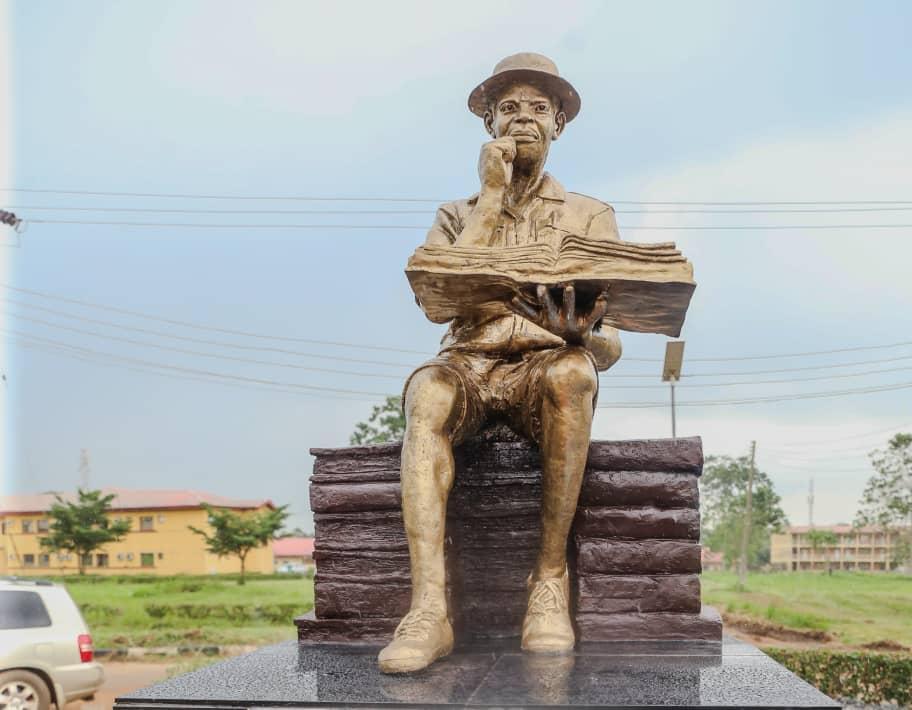
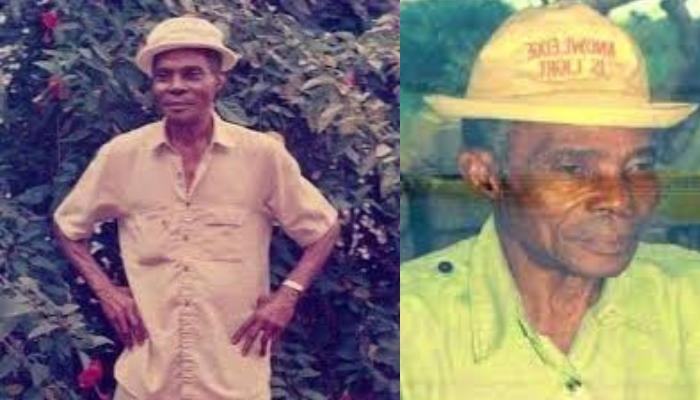
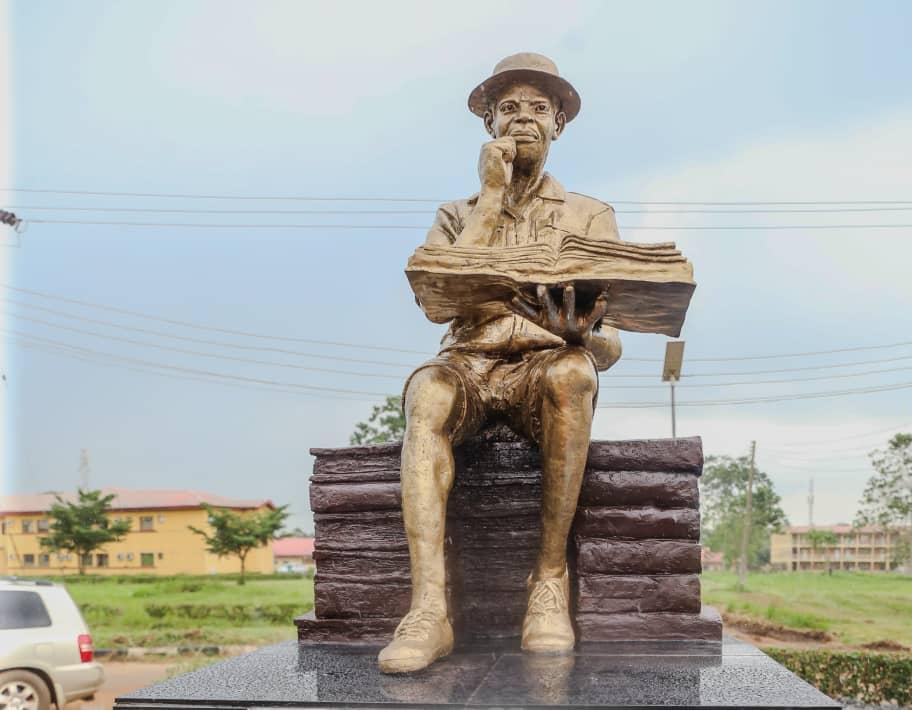
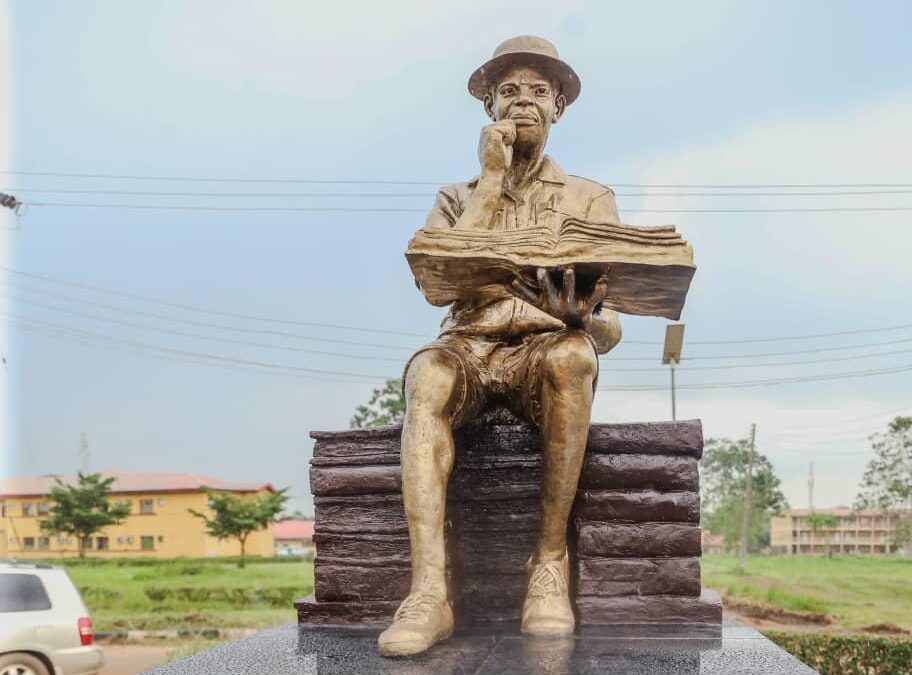
Mounted upon a raised platform, the old man sits with a familiar stoic grace, exuding both ascetic strength and intellectual fervour. He appears as generations knew him: in his trademark bowler hat, khaki shorts, and simple shirt. In one hand, he holds an open book, an unambiguous tribute to his lifelong devotion to learning. In the other, he raises a clenched fist, carved with such anatomical precision: muscles taut, veins alive, that one could imagine Michelangelo himself guiding the sculptor’s hand.
This striking image marked the unveiling of the life-size statue of the late Dr. Tai Solarin, donated by Omooba Yemisi Adedoyin Shyllon to the Tai Solarin University of Education (TASUED), Ijagun, Ogun State, on Thursday, 30 October 2025. The ceremony gathered distinguished figures, including the Pro-Chancellor, Prof. Rahman Adisa Bello; the outgoing Vice-Chancellor, Prof. Oluwole Sikiru Banjo; and the eminent artist-scholar Prof. Funke Ifeka.
For Shyllon, prince, collector, philanthropist, and cultural archivist, the day carried an intimate resonance. He recounted that as a 12-year-old boy in 1965, he stumbled upon Solarin’s iconic essay May Your Road Be Rough, published in the Nigerian Tribune the previous year. The paradox of the title startled him, compelling him to read on. That reading, he said, was life-altering.
“I read that article and said, ‘Wow, how can somebody wish another person that his road should be rough?’ That was what inspired me to read the piece. I must tell you, it influenced my life. And I followed Tai Solarin ever since,” he recalled. He added that his paternal grandmother often spoke of a certain man who visited Lagos to gather the unclaimed dead and give them dignified burials. That man, he later learned, was Tai Solarin.
Beyond the essay’s exhortation to embrace the rigours that shape character, another motivation moved him to make this donation. “To crown it all, I was honoured by this great university recently with a Doctor of Science degree. And I felt, how do I show my appreciation to both the dead and the living? To the dead, because Tai Solarin, through the article I read, shaped the path I took in life. And so, I decided to do this.”
This gesture forms part of a long-standing pattern of cultural philanthropy. “This is not the first time. I’ve done it at the University of Ibadan, the University of Lagos, and at Pan-Atlantic University, where I established the biggest museum of art in Nigeria, which I’m still supporting,” he said. “I believe my purpose in life is to give and not to receive… You make a living by what you get, but you make a life by what you give.”
For Shyllon, giving is more than altruism; it is legacy-making. His philanthropy flows from a personal philosophy anchored in permanence, meaning, and cultural memory. “Many people have come into this world who were very rich but left no legacy. Once they are dead, they are forgotten,” he reflected. “My intention is that I don’t want to be forgotten. I want to be remembered for my contributions to life.”
The Pro-Chancellor, Prof. Bello, affirmed the university’s gratitude. He recounted how, shortly after receiving his honorary degree, Shyllon expressed a desire to do something on campus that would “outlive all of us.” Though the university already had a gate-side sculpture of Solarin, Shyllon insisted on commissioning a true monumental work; one befitting the stature of the man and the values he represented. “You may not know the value of what you have here,” Bello noted, “but those who understand will appreciate it.”
Shyllon as an Art Historian
Prof. Ifeka’s description of Shyllon as “one of Nigeria’s greatest art historians” was no hyperbole. Though trained in engineering, law, and business, Shyllon possesses an encyclopedic command of modern and contemporary Nigerian art. “When you talk about artists around the world, he can give you their data; sometimes more than those of us who studied art history,” she observed. In a country where artists often struggle for institutional support, Shyllon’s patronage has been a lifeline.
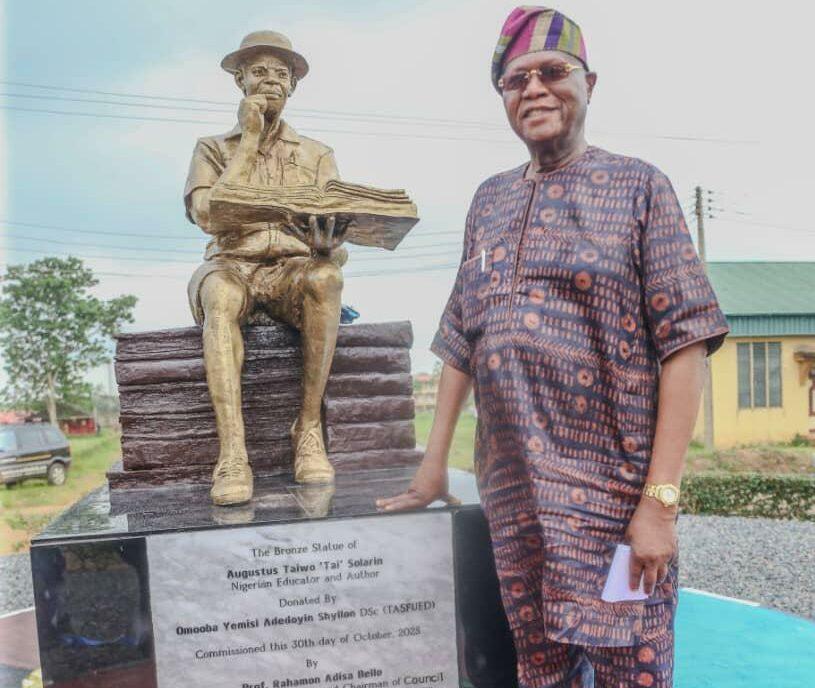
Despite economic pressures, he has continued to fund art projects and support artists nationwide. “We have sculptures all over this campus, camouflaged to look like bronze,” Prof. Ifeka noted. “But he is giving us a real bronze statue. A bronze statue costs millions of naira and lasts forever… He is worthy of the man we are immortalising, Tai Solarin.”
Indeed, Shyllon’s biography reads like that of a many-sided renaissance figure. A prince of Ake in Abeokuta, Ogun State, he studied engineering at the University of Ibadan, law at the University of Lagos and the Nigerian Law School, and earned an MBA from the University of Ife. He later received an honorary Doctor of Letters (D.Litt.) degree from the University of Port Harcourt. Professionally, he rose from sales engineer to marketing manager at Tractor and Equipment (UACN), and thereafter became marketing director; and at a time legal adviser, to Nigerite Limited.
Yet his global recognition springs from a different realm: art collecting. Over several decades, Shyllon has amassed what many consider the most extensive private art collection in Nigeria; between 6,000 and 7,000 works, supported by a substantial photographic archive documenting traditional festivals and cultural life. His collection spans generations: from pioneers like Aina Onabolu to iconic modernists like Ben Enwonwu and Bruce Onobrakpeya, and from celebrated contemporaries like El Anatsui to rising experimentalists.
Crucially, he funded and established the Yemisi Shyllon Museum of Art (YSMA) at Pan-Atlantic University, Nigeria’s first privately funded university museum. He donated roughly one thousand artworks to its opening collection and continues to support its operations. This single act significantly strengthened Nigeria’s cultural infrastructure and permanently expanded public access to art.
Across southern Nigeria, his philanthropy includes donating statues, refurbishing museum galleries, supporting artists’ training, and placing artworks in universities and public institutions. Recent media reports highlight his renovation of the exhibition hall at the National Museum of Unity in Ibadan, one among many quiet but transformative interventions.
The Man, Tai Solarin
If Shyllon’s generosity honours Tai Solarin, it is because Solarin himself was a figure of fierce moral purpose. Born in Ikenne, Ogun State, on 20 August 1916, Solarin’s life spanned continents and causes. After early schooling at Wesley School, he joined the British Royal Air Force during the Second World War, serving as a navigator. The post-war years found him studying at the University of Manchester and later the University of London. In 1951, he married Sheila Mary Tuer, an Englishwoman who would become his lifelong partner in activism and education.
On returning to Nigeria, Solarin taught at Molusi College in Ijebu Igbo and, in 1952, became its principal. Four years later, he resigned to establish Mayflower School; the institution that would seal his legacy as one of Nigeria’s most influential educators. Solarin’s voice also resounded in the public sphere; he became an unrelenting social critic, aligned in spirit and courage with figures like Wole Soyinka, Ayodele Awojobi, and Gani Fawehinmi.
The unveiling of his statue at TASUED is therefore not merely ceremonial. It is a symbolic restoration: an embodiment of the moral fire, intellectual audacity, and civic courage that Solarin represented. Through Shyllon’s philanthropy, Solarin’s image now stands renewed, inviting future generations to contemplate the rigour that shapes character, the resilience that strengthens society, and the generosity that binds one life to many. In affirming Solarin’s legacy, Shyllon has once again affirmed his own: a lifelong project of cultural preservation, intellectual investment, and the generosity of a man determined to ensure that memory, and meaning, endure.